Interactive Aquarium Engine
A living 3D aquascape with schooling fish, feeding, and changing light
Solo Developer
2025 - Present
Team details
Solo Project
 Open full size
Impact
Overview
A procedural Three.js aquarium built into this portfolio.
Read the full overview
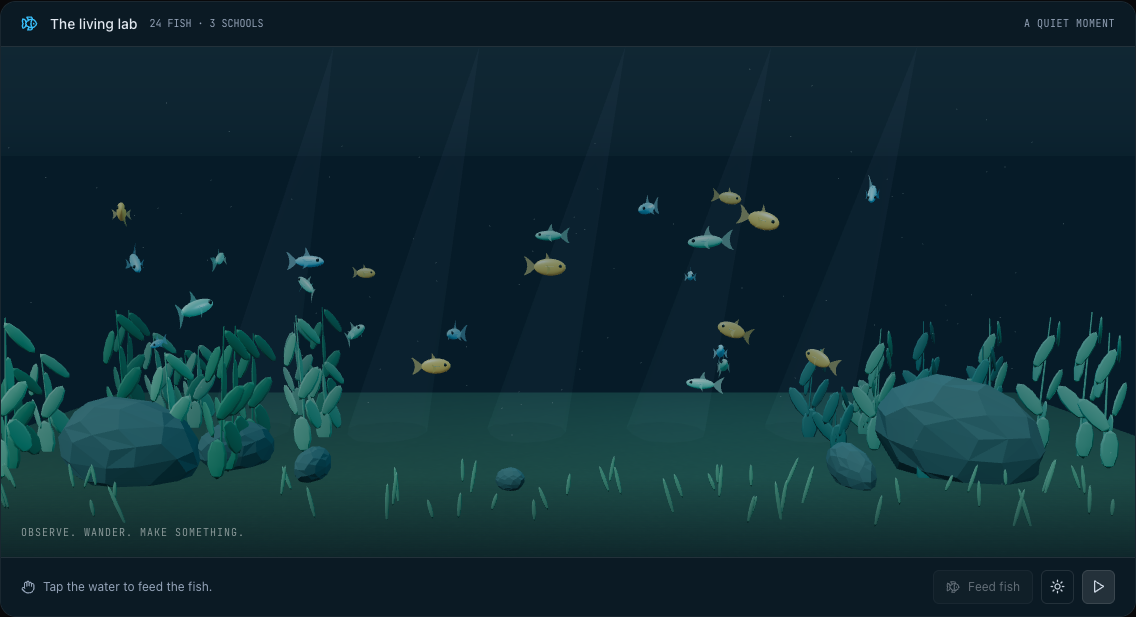
Three schools of fish swim through layered plants and rocks, align with their neighbors, and gather around food dropped into the water. Daylight and moonlight change the atmosphere. The renderer pauses off-screen, respects reduced motion, and falls back to the original Canvas aquarium when WebGL is unavailable.
A procedural Three.js aquarium built into this portfolio. Three schools of fish swim through layered plants and rocks, align with their neighbors, and gather around food dropped into the water. Daylight and moonlight change the atmosphere. The renderer pauses off-screen, respects reduced motion, and falls back to the original Canvas aquarium when WebGL is unavailable.
Inside the build
Contributions / 04
- Combined target seeking, alignment, and separation with a bounded feeding simulation
- Generated fish, plants, rocks, and sand procedurally; merged plant geometry to reduce draw calls
2 more contributions
- Loaded Three.js only in the Lab, capped pixel density, and paused rendering when hidden
- Added explicit pause, feed, and lighting controls, with static reduced-motion startup and a Canvas fallback
Tech Stack
Challenges
- 1Giving fish believable collective motion without a full physics engine
- 2Creating an atmospheric scene without downloading large models or textures
- 3Managing GPU resources, browser visibility, and responsive rendering inside React
- 4Keeping the experience usable with reduced motion and without WebGL
Solutions
- ✓Combined target seeking, alignment, and separation with a bounded feeding simulation
- ✓Generated fish, plants, rocks, and sand procedurally; merged plant geometry to reduce draw calls
- ✓Loaded Three.js only in the Lab, capped pixel density, and paused rendering when hidden
- ✓Added explicit pause, feed, and lighting controls, with static reduced-motion startup and a Canvas fallback
Key Learnings
Balancing scene detail, draw calls, and browser performance
Designing interactive simulations with keyboard-accessible controls
Managing animation and GPU resource lifecycles in React